Introduction
MSC CoSim 2025.1 PC Software is an advanced co-simulation platform developed by Hexagon MSC Software. It is designed to enable seamless integration between different engineering simulation tools, allowing users to perform accurate and efficient multidisciplinary simulations. MSC CoSim plays a crucial role in modern computer-aided engineering (CAE) workflows by linking multibody dynamics, finite element analysis (FEA), and control system simulations into a unified environment.
In complex engineering systems—such as vehicles, aerospace structures, industrial machinery, and mechatronic systems—no single simulation tool can capture all physical behaviors accurately. MSC CoSim addresses this challenge by allowing multiple solvers to work together in real time. The 2025.1 release enhances performance, stability, and compatibility with the latest simulation tools, making it a reliable solution for high-fidelity virtual prototyping.

Overview
MSC CoSim is built to support multidisciplinary and multiphysics simulation, enabling engineers to analyze how different physical domains interact within a single system. Instead of simplifying models or relying on assumptions, users can connect specialized solvers to exchange data dynamically during simulation.
For example, MSC CoSim allows:
-
Multibody dynamics solvers to exchange forces and motions with FEA solvers
-
Structural flexibility to influence system-level motion
-
Control systems to interact with realistic mechanical models
MSC CoSim 2025.1 improves data exchange efficiency, reduces numerical instability, and supports newer solver versions across the MSC software ecosystem. This makes it particularly valuable for organizations focused on accuracy, design validation, and reducing reliance on physical testing.
Description
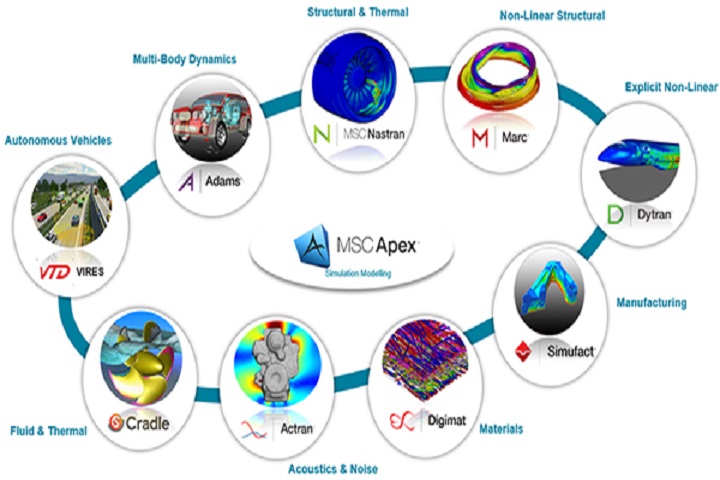
MSC CoSim acts as a co-simulation framework rather than a standalone solver. Its primary function is to manage communication, synchronization, and data exchange between different simulation environments.
Co-Simulation Architecture
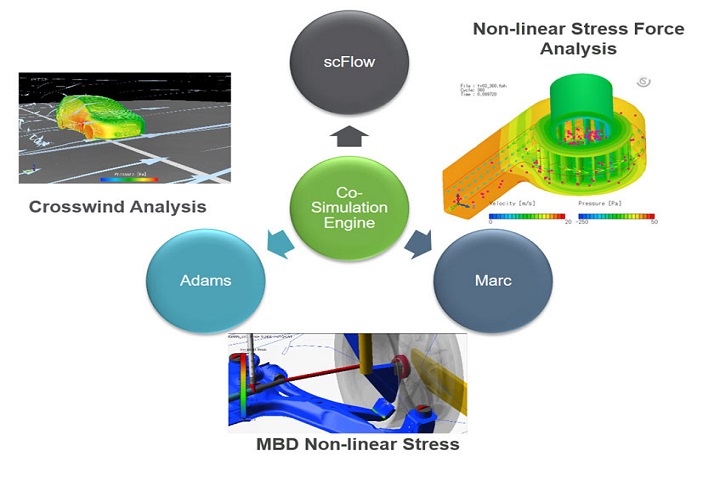
The software coordinates time steps between connected solvers, ensuring consistent and stable data transfer. Each solver runs its own physics calculations while MSC CoSim manages the coupling logic, allowing the entire system to behave as a unified virtual model.
Solver Integration
MSC CoSim is commonly used to connect tools such as multibody dynamics software, finite element solvers, and control system environments. This enables engineers to combine rigid-body motion, flexible body deformation, and control logic into one simulation loop.
High-Fidelity System Modeling
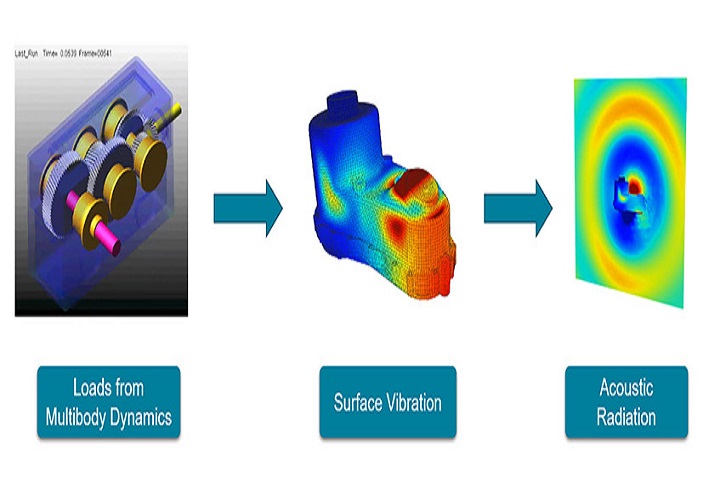
By using co-simulation, engineers can avoid oversimplified assumptions. Structural deformations computed in FEA tools can directly affect system motion, while dynamic loads from motion solvers can influence stress and fatigue calculations.
User Workflow
MSC CoSim provides configuration tools that allow users to define interfaces, signal mappings, and synchronization settings between solvers. This structured workflow helps manage complex simulations while maintaining clarity and repeatability.
Key Features
Multidisciplinary Co-Simulation
MSC CoSim enables real-time coupling between different simulation domains, including multibody dynamics, structural mechanics, and control systems.
Accurate Data Exchange
The platform ensures precise transfer of forces, displacements, velocities, and control signals between solvers at each simulation step.
Improved Stability and Performance
Version 2025.1 introduces optimizations that improve numerical stability and reduce simulation run time, even for large and complex models.
Flexible Solver Coupling
Users can configure one-way or two-way coupling depending on analysis requirements, allowing flexibility in simulation fidelity and performance.
Support for Flexible Bodies
MSC CoSim enables flexible body behavior from FEA solvers to influence motion simulations, improving realism in dynamic analyses.
Scalable for Complex Systems
The software is suitable for small assemblies as well as large, highly detailed systems used in automotive, aerospace, and industrial applications.
Reduced Physical Prototyping
By capturing real-world interactions more accurately, MSC CoSim helps reduce the need for costly and time-consuming physical testing.
How to Install
Installing MSC CoSim on a Windows PC follows a standard MSC Software installation workflow:
-
Verify System Requirements
Ensure your PC meets the minimum or recommended hardware and software requirements. -
Run the Installer
Launch the setup executable with administrator privileges and follow the on-screen instructions. -
Select Installation Components
Choose MSC CoSim and any related components or interfaces required for your simulation environment. -
License Configuration
Configure licensing using the MSC licensing system (such as MSC One or node-locked licensing). -
Complete Installation
Finish the installation and restart your system if prompted. -
Post-Installation Setup
Verify solver connections and environment variables to ensure successful co-simulation integration.
System Requirements
Minimum System Requirements
-
Operating System: Windows 10 (64-bit) or Windows 11
-
Processor: Intel Core i5 or equivalent
-
RAM: 8 GB minimum
-
Storage: 5–10 GB free disk space
-
Graphics: Standard graphics adapter